Know SPEED
SPEED — Structured Parallel Engineering for Evolved Deployment — is a way of delivering software in which the specification is authoritative, quality is enforced mechanically, and cooperating roles coordinate through explicit boundaries. This is the map. Every area is a hub; every hub links to what to read, reference, and practice next.
The SPEED Big Picture
Seven knowledge areas, one delivery pipeline. Every element links to tutorials, references, exercises, and field notes — start anywhere and follow the flow.
SPEED-BOK v1.4.7The forward pipeline
The governance & learning loop
SPEED at a glance
How work moves: five tiers of specification, three gates
Order is fixed · no stage is skipped- T1CharterSovereign direction and scope.
- T2CanonLiving architecture and authoritative terms.
- T3FeatureLocked acceptance criteria.
- T4ExecutionThe bounded unit of work.
- T5GateExecutable quality checks.
- G1StructuralDoes it conform to canon?
- G2FunctionalDoes it do what it claims?
- G3OperationalIs it safe to release?
The Pentorb: five capabilities an implementation must show
Principles are asserted · capabilities are exhibited- LeverageFind the point where governed effort moves the outcome most, and apply it there.Canon ManagementSpec Engineering
- ContinuityCapture verified state so work resumes with full context.Canon ManagementSpec Engineering
- LegibilityRender the system so time-poor people can read it and act.Observability and Run EventsQuality Arbitration
- TrustChecks, balances and boundaries; trust granted only as it is earned.Governance and ComplianceQuality Arbitration
- TempoIterate as fast as delivery allows while humans hold the gates that matter.Flight ExecutionRelease and Deployment
Each capability is built by the knowledge areas above. None comes from one area alone.
What SPEED is not
- A project-management technique grafted onto engineering
- A documentation standard
- A productivity system
- A compliance checklist
It is a way of thinking about delivery; the practices follow from it.
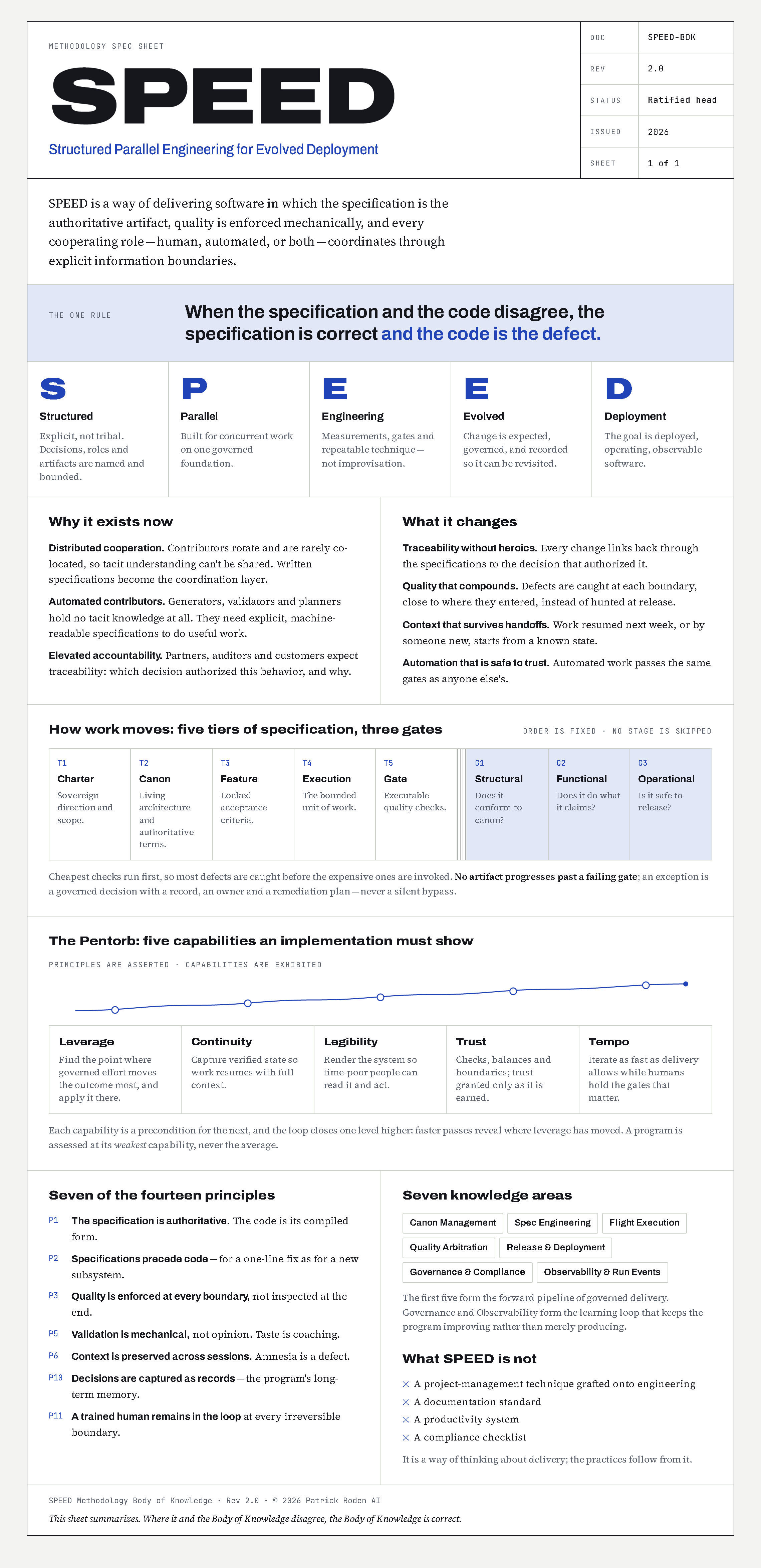
From SPEED-BOK v2.0, ratified 2026-08-17
From knowing to running
This map teaches the methodology. Turning it into a running program — a live canon, real gates, a working pipeline — is what the implementor path is for. Start where the practice begins.
Begin the implementor path