Developer Insights & Tutorials
Deep dives into AI, web development, and the tools shaping modern software.

The Six-Week Season: How Holiday Lighting Crews Get Their Hours Back
Every install is a quote, a date and a callback, and they all land in the same six weeks. What changes when the panel holds the schedule and Claude does the writing.
 Patrick RodenAugust 17, 2026
A Week at On Top Home Services: What the Panel and Claude Actually Did
Six buildings quoted Monday. A month of posts from eight photos Tuesday. A two-star review answered Wednesday in a way that won a booking three weeks later. One real week, from the owner side.
Patrick RodenAugust 17, 2026
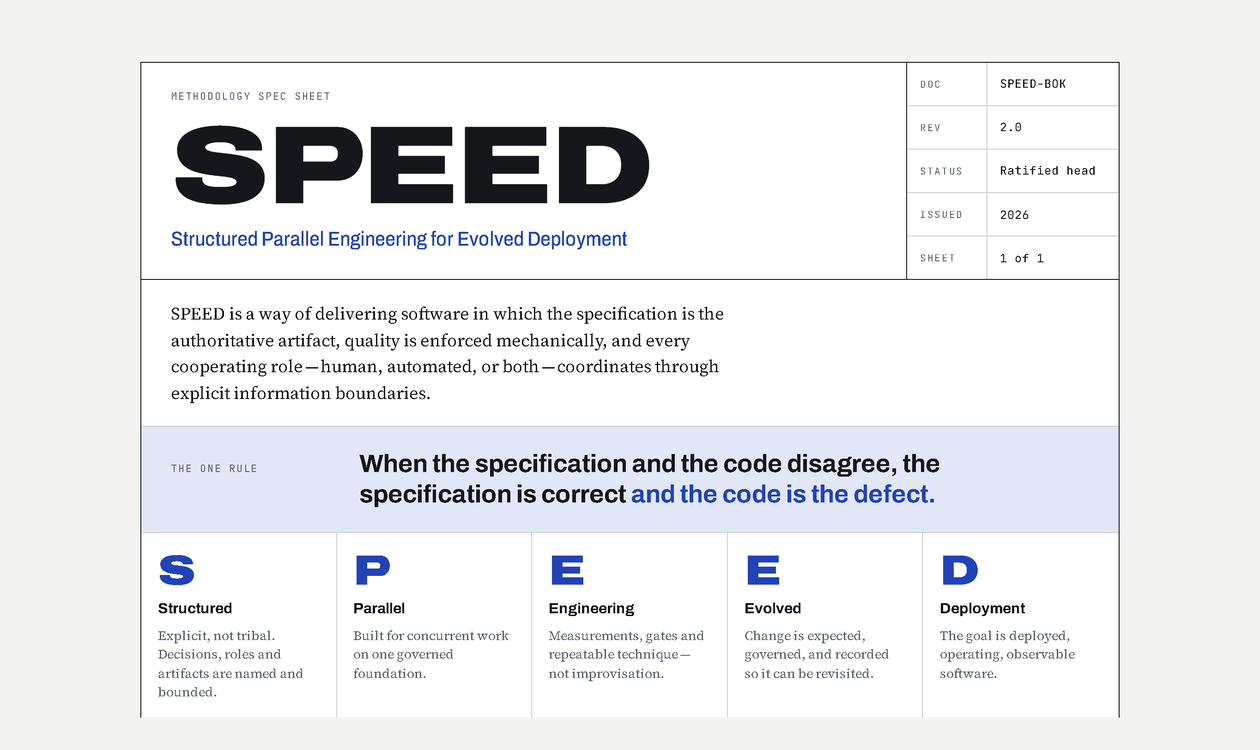
The Standard We Build To (And Why Most Teams Are Still One Argument Behind)
Spec-first, verify-before-assert, governed gates, tenant sovereignty, agent-orchestrated delivery. The disciplines that decide whether a team gets faster or just louder — and an honest note about the part we do not publish.
Patrick RodenAugust 17, 2026
The 800-Line Requirements Worksheet: What Survives Contact With a Real EHR
A public-sector health record procurement runs north of 800 requirements, and a large share of them are duplicates, solution language, or desktop-software fossils. A field guide to reducing one — and to turning the vendor response column into an acceptance test plan.
Patrick RodenJuly 31, 2026
The Interface List Is the Project: HL7, FHIR, and the 2008 Financial System
The functional requirements get the working sessions. The eight-row interface matrix at the back carries the schedule risk. Integration patterns, identity resolution without a national identifier, and the consent problem that breaks naive designs.
Patrick RodenJuly 31, 2026
Federating a Nation's Health Record: Why the Whiteboard Design Keeps Losing
Centralized national health records have failed everywhere they have been attempted; federated ones work. The difference is the shape of the value curve — and segmentation settles the argument on privacy grounds, not engineering ones.
Patrick RodenJuly 31, 2026
The Half-Closet Server: A Field Guide to Property-Local AI
Spec, build, and govern a self-hosted AI node — hardware tiers, model serving, a records vault with RAG, a bounded agent loop, and the power math to keep it running. No cloud required.
Patrick RodenJuly 20, 2026
Reading the Web's Mind: A Developer's Field Guide to Semrush
You already know how to read a database. Semrush is a query engine over the web's demand and competition — here is how to run a 15-minute competitive teardown, the developer way.
Patrick RodenJuly 16, 2026
AI API Key Security: Why Most Teams Are Getting It Wrong (And How to Fix It)
LLM API keys are not ordinary secrets. A leaked key does not just expose data — it runs up a billing tab, impersonates your brand, and can be weaponized in minutes. Here is the stance on securing them properly.
 DevForge TeamMarch 15, 2026
HashiCorp Vault vs Kubernetes Secrets: Which Should You Use for AI Workloads?
Kubernetes Secrets are built-in and convenient. HashiCorp Vault is powerful and production-grade. Here is a direct comparison to help you decide which belongs in your AI infrastructure stack.
DevForge TeamMarch 15, 2026
Kubernetes Network Policies vs Service Mesh: Choosing the Right Privacy Layer for AI Traffic
Network Policies enforce traffic rules at the kernel level. A service mesh adds mTLS, observability, and policy enforcement at the application layer. For AI inference pipelines, the choice has real security consequences.
DevForge TeamMarch 15, 2026
Building an AI Constitution: How to Give Your Model a Moral Backbone
Constitutional AI is the technique that separates safe, reliable AI systems from unpredictable ones. Here's how to design, write, and deploy a constitution for any AI model you build with.
DevForge TeamMarch 13, 2026
The Scrum Master in the AI Era: What Survives, What Evolves, and What Gets Automated Away
AI tools are compressing the mechanical layer of the Scrum Master role — ceremonies, metrics, backlog hygiene. What remains is the work that actually matters. Here's what that looks like in practice.
DevForge TeamFebruary 27, 2026
The AI-to-AI Commerce Layer: How Autonomous Agents Are About to Rewrite Trade, Contract Law, and Government Policy
What happens when two AI systems negotiate a deal, sign a blockchain contract, and exchange intellectual property — all without a human in the loop? The infrastructure is closer than you think, and the policy gap is enormous.
Patrick RodenFebruary 26, 2026
Emotional Intelligence in the AI-Driven Workplace: The Skills That Cannot Be Automated
As AI compresses the administrative layer of HR work, the skills that remain — emotional intelligence, conflict resolution, nonviolent communication, and change management — become the entire job description. Here is what that means for HR professionals and the organizations they serve.
Patrick RodenFebruary 25, 2026
Cursor, AI-Native IDEs, and Claude Code Alignment: What Developers Need to Know
Cursor represents a new theory about how developers should work with AI — the codebase as context, not the file. Combined with Claude Code and Constitutional AI alignment, these tools are reshaping what responsible AI-assisted development looks like.
DevForge TeamFebruary 25, 2026
The Four Roles Becoming One: How AI Is Collapsing the PM, BA, PO, and Developer Boundary
For decades, software teams separated project management, business analysis, product ownership, and development into distinct roles with distinct skill sets. AI-facilitated rapid deployment is ending that separation — and the teams winning right now are the ones who figured it out first.
Patrick RodenFebruary 25, 2026
AI and the Bullshit Job Problem: What Happens When the Economy Can No Longer Afford Fake Work
David Graeber argued that a huge portion of modern jobs exist primarily to justify themselves. AI is about to run an unforgiving audit. Here is what that means for the sleazy sales rep, the legacy system guardian, and the professional box-checker — and what they can do about it.
Patrick RodenFebruary 25, 2026
AI Agent Security: 7 Guardrails Every Production Agent Needs
Autonomous agents are powerful — and dangerous without proper guardrails. Here are the 7 security patterns that separate demos from production-ready agents.
DevForge TeamFebruary 23, 2026
BrightLocal and AI: The Complete Guide to Citation Building and Local SEO in 2026
Local search is won or lost on NAP consistency, citation volume, and review velocity. Here is how to use BrightLocal for the infrastructure — and AI to scale the content, responses, and reporting around it.
DevForge TeamFebruary 23, 2026
Google Ads in the AI Era: Smart Bidding, Performance Max, and Campaigns That Actually Scale
Google Ads has fundamentally changed. Smart Bidding, Responsive Search Ads, and Performance Max have replaced manual optimization with machine learning — here is how to work with the algorithm instead of against it.
DevForge TeamFebruary 23, 2026
Meta Ads in 2026: How AI Advantage+ Is Changing What You Need to Do to Win
Meta's advertising platform has shifted dramatically toward AI automation. Advantage+ Shopping, broad targeting, and creative-as-targeting have redefined what successful Meta Ads management looks like — here is the updated playbook.
DevForge TeamFebruary 23, 2026
Vibe.co and AI: The Complete Guide to Running Connected TV Ads Without an Agency
Vibe.co made streaming TV advertising accessible to businesses with any budget. Combine it with AI video tools and you have broadcast-quality campaigns at a fraction of traditional production costs.
DevForge TeamFebruary 23, 2026Building Your First AI Agent in JavaScript: A Step-by-Step Guide
Forget the hype. This tutorial walks you through building a working AI agent from scratch in under 100 lines of JavaScript — no frameworks required.
DevForge TeamFebruary 22, 2026
Kiro Files Explained: The .kiro Directory, Steering Files, and Specs
The .kiro directory gives AI coding tools persistent memory of your project. Here is what every file does, how to set it up, and why it changes how you build with AI.
DevForge TeamFebruary 22, 2026
How to Use Claude.ai to Build Business, Design & Technical Docs Fast
Claude.ai eliminates blank-page paralysis for every document a startup needs — pitch decks, sales playbooks, design specs, and technical specs. Here is the complete workflow.
DevForge TeamFebruary 22, 2026The Complete Guide to Bolt.new: Prompts, Kiro Files, and Iterative Development
Bolt.new builds full-stack apps in the browser. The difference between a frustrating experience and a productive one is entirely in how you prompt, structure context, and iterate. Here is the complete playbook.
DevForge TeamFebruary 22, 2026
How to Debug Bolt.new Projects with Claude.ai
When Bolt loops on a problem, the fix is not more Bolt prompts. Here is the step-by-step workflow for using Claude.ai to diagnose stuck Bolt builds and write targeted fixes that actually work.
DevForge TeamFebruary 22, 2026
The Complete Guide to Claude Code: Agentic Coding in Your Terminal
Claude Code runs in your terminal, reads your files, writes changes to disk, and executes commands. Here is how to install it, configure it, and use it effectively — including on Windows PowerShell.
DevForge TeamFebruary 22, 2026Claude Code Security Model, Permissions, and Safe Workflow Practices
Understanding what data leaves your machine, how the permission system works, what to auto-approve vs. require manual approval for, and how git protects you when Claude Code goes wrong.
DevForge TeamFebruary 22, 2026
The Complete ChatGPT Guide for Developers: Prompts, Models, and Workflows
ChatGPT is a far more capable development tool than most developers realize — but only when prompted precisely. This guide covers everything from the four-part prompt structure to reasoning models, Code Interpreter, and building GPTs for recurring workflows.
DevForge TeamFebruary 22, 2026
ChatGPT Custom Instructions, Memory, and GPTs: Stop Repeating Yourself
Every new ChatGPT conversation starts blank by default. Custom Instructions, Memory, and GPTs eliminate that overhead — giving ChatGPT persistent context about your role, stack, and preferences. Here is how to configure all three for professional development work.
DevForge TeamFebruary 22, 2026
The Business Analyst in the AI Era: From Documentation Layer to Judgment Layer
AI can generate requirements, write user stories, and produce gap analyses from a single prompt. That doesn't make the BA role obsolete — it makes the judgment, validation, and stakeholder work more valuable than ever. Here is how modern BAs are adapting.
DevForge TeamFebruary 22, 2026
The Project Manager in the AI Era: Smarter Planning, Faster Reporting, Better Risk Management
AI tools are compressing the administrative overhead of project management — status reports, risk registers, milestone plans, and stakeholder updates can all be drafted in minutes. The PM who masters these tools will have more time for the work that actually requires human judgment.
DevForge TeamFebruary 22, 2026
The Product Owner in the AI Era: Why SDLC Literacy Is Now a Competitive Advantage
AI can write specs, generate user stories, score backlogs, and build roadmaps. But a product owner who does not understand the SDLC will make poor decisions with AI-generated artifacts. Here is why deep SDLC literacy — combined with AI fluency — is now the defining skill of the modern PO.
DevForge TeamFebruary 22, 2026
Software Sales in the AI Era: The New Pipeline, the New Rep, and the Lean Vendor Advantage
AI has collapsed the information asymmetry that traditional software sales relied on. Buyers research independently, arrive informed, and have less patience for generic pitches. The reps who thrive are building genuine insight, developing champions, and using AI to do the preparation work that makes every conversation count.
DevForge TeamFebruary 22, 2026
The Graphic Designer and Video Editor in the AI Era: What Changes, What Does Not, and How to Build a Career That Compounds
AI image and video tools have made "good enough" visual output accessible to non-designers. The designers who thrive are not fighting this — they are using AI for production efficiency while concentrating their expertise on the strategic, brand-coherent, and creatively original work that AI cannot replace.
DevForge TeamFebruary 22, 2026Smartsheet in 2026: Smart Agents, AI Formulas, and the Shift to Intelligent Work Management
Smartsheet went private in an $8.4B deal and is now AI-ifying the entire platform. More than a third of dashboard elements are now AI-generated. Here is what is coming and what it means for how your team manages work.
DevForge TeamFebruary 21, 2026
Smartsheet vs Excel: When to Use Which (And How to Use Both)
"Should I use Smartsheet or Excel?" is the wrong question. The right question is: which one for this specific use case? This guide maps 15 common business scenarios to the right tool.
DevForge TeamFebruary 21, 2026
What Is MCP? The Protocol Every Developer Needs to Know in 2026
Model Context Protocol (MCP) has become as fundamental to AI development as HTTP is to the web. Here's what it is, why it matters, and how to start building with it today.
DevForge TeamFebruary 21, 2026
The 10 Excel Formulas That Replace 90% of Manual Work
You do not need 400+ functions. You need 10. These are the formulas that eliminate copy-paste, manual lookups, and repeated analysis — ranked by how much manual work they replace.
DevForge TeamFebruary 20, 2026
Excel in 2026: Copilot Agent Mode, Dynamic Arrays, and Why Spreadsheets Still Win
Every year someone declares spreadsheets dead. Every year, 1.1 billion people open Excel. In 2026, Excel has an AI copilot that writes formulas, builds pivot tables, and generates charts from natural language. Here is what actually changed.
DevForge TeamFebruary 20, 2026
Seven NDA Red Flags Every Developer Should Recognize Before Signing
Most developers sign NDAs without reading them. Here are the seven clauses that should make you pause, push back, or walk away.
DevForge TeamFebruary 20, 2026
Software Patents After Alice: What Developers Need to Know in 2026
The Alice decision changed everything about software patents. Here is what is still patentable, what is not, and how to protect your innovations without spending $30K.
DevForge TeamFebruary 20, 2026
Five Operating Agreement Mistakes That Kill Tech Startups
Co-founder disputes are the number one startup killer. These five operating agreement oversights are behind most of them — and all are preventable.
DevForge TeamFebruary 20, 2026Agile in the AI Era: How AI Coding Tools Change Scrum, Kanban, and Sprint Planning
AI coding tools collapsed the build phase from days to hours. That changes every agile ceremony — and the teams winning are those who figured out specifications are now the bottleneck.
DevForge TeamFebruary 20, 2026
The Plain Language Advantage: How Clear Writing Eliminates the #1 Cause of Software Bugs
Ambiguous requirements are the most expensive source of software defects. Here is how plain language writing eliminates bugs before a single line of code is written.
DevForge TeamFebruary 20, 2026
Scrum vs Kanban in 2026: A Developer's Guide to Choosing the Right Agile Framework
Scrum and Kanban solve different problems. Here is how to choose between them — and when Scrumban is the honest answer.
DevForge TeamFebruary 20, 2026
AI Mockup Tools Compared: Figma AI vs v0.dev vs Bolt.new vs Visily in 2026
Six AI mockup and design tools tested with the same prompt. Here is what each one actually produces, what it costs, and when to use it.
DevForge TeamFebruary 20, 2026
Use Cases vs User Stories: When to Use Each and How They Work Together
Use cases and user stories are often treated as competitors. They are actually complementary tools that serve different phases of the same requirements process.
DevForge TeamFebruary 20, 2026The Developer's Security Checklist: 20 Things to Fix Before You Deploy
Most security breaches exploit known vulnerabilities that a checklist would have caught. Here are the 20 security checks every developer should run before shipping to production.
DevForge TeamFebruary 20, 2026
Docker for JavaScript Developers: The Only Guide You Need
Docker eliminates "works on my machine" forever. Here is everything a JavaScript developer needs to know to containerize their apps and run them consistently anywhere.
DevForge TeamFebruary 20, 2026
GitHub Actions CI/CD: From Zero to Production Pipeline in 30 Minutes
A working CI/CD pipeline catches bugs before production and deploys automatically. Here is how to build one with GitHub Actions in under 30 minutes.
DevForge TeamFebruary 20, 2026Securing AI Applications: Prompt Injection, Data Leakage, and API Key Management
AI applications introduce a new category of security vulnerabilities that traditional checklists miss. Here is how to secure LLM integrations before they ship.
DevForge TeamFebruary 20, 2026TDD in 2026: How Test-Driven Development Works with AI Coding Tools
AI coding tools change TDD in surprising ways. Writing tests first gives AI tools the specification they need to generate correct implementations — making TDD more valuable, not less.
DevForge TeamFebruary 20, 2026
Playwright vs Cypress in 2026: Which E2E Framework Should You Choose?
Playwright and Cypress are both excellent E2E testing frameworks. The right choice depends on your stack, team size, and what you're actually testing. Here is the honest comparison.
DevForge TeamFebruary 20, 2026
Testing AI Features: A Practical Guide to Testing LLM Integrations
Testing code that calls a language model requires a different approach than testing deterministic functions. Here is a practical framework for testing AI features reliably.
DevForge TeamFebruary 20, 2026
Pricing Your Developer Tool: The Complete Strategy Guide for Technical Founders
Most developer tools are underpriced. Here is a practical framework for pricing your developer tool — from your first customer to enterprise contracts.
DevForge TeamFebruary 20, 2026
SaaS Metrics Explained: The 10 Numbers Every Technical Founder Must Track
Most technical founders track the wrong metrics. Here are the 10 numbers that actually predict whether your SaaS business will succeed — and how to calculate them correctly.
DevForge TeamFebruary 20, 2026
From Side Project to Startup: A Developer's Guide to Validating Your Product Idea
Most side projects die because developers build before validating. Here is a systematic framework for testing whether your idea is a business before writing production code.
DevForge TeamFebruary 20, 2026
Building a Pitch Deck as a Technical Founder: What Investors Actually Want to See
Technical founders make predictable pitch deck mistakes. Here is what early-stage investors actually evaluate — and how to structure a deck that leads to term sheets.
DevForge TeamFebruary 20, 2026
Technical SEO for Next.js: The Complete Developer's Guide
Next.js is inherently SEO-friendly — but still requires deliberate optimization. Here's how to implement every technical SEO requirement in Next.js 14 App Router.
DevForge TeamFebruary 19, 2026
AI Video Tools Compared: Atlabs vs HeyGen vs Synthesia vs Runway vs Higgsfield in 2026
We tested the same marketing brief across five leading AI video platforms, then added Higgsfield to the mix. Here's what each tool does best, where it loses, and exactly how to choose.
DevForge TeamFebruary 19, 2026
Google Ads for SaaS: A Technical Founder's Playbook
When to start Google Ads, how to structure your first campaigns, what to bid on, and how to scale what's working — without wasting your early budget.
DevForge TeamFebruary 19, 2026Vibe Coding in 2026: What It Is, When It Works, and When to Stop
Vibe coding went from a tweet to a cultural phenomenon in under a year. Here's an honest, complete guide to what it is, when it's the right tool, when it fails, and how to evolve from ad-hoc prompting into workflows that actually scale.
DevForge TeamFebruary 19, 2026
The Vibe Coding Toolkit: Every AI Coding Tool Compared (2026 Edition)
A comprehensive comparison of 10+ AI coding tools organized by how they work — full-app generators, IDE-integrated assistants, and terminal agents — with clear guidance on which tool fits which situation.
DevForge TeamFebruary 19, 2026
Vibe.co and the Rise of Self-Serve CTV: How Streaming TV Advertising Became Accessible to Every Business
Connected TV advertising was once reserved for brands with six-figure budgets and agency teams. Vibe.co changed that — here's everything you need to know about self-serve streaming TV advertising.
DevForge TeamFebruary 19, 2026Zeely AI for Small Business Marketing: From Product Link to Running Ads in Minutes
Zeely consolidates the entire Meta ad workflow — creative generation, campaign setup, optimization, and reporting — into one AI-powered platform. Here's how it works and when it makes sense.
DevForge TeamFebruary 19, 2026
Atlabs vs Zeely vs Vibe Studio: Which AI Video Ad Tool Is Right for Your Business?
Three AI-powered video tools, three very different jobs. This comparison cuts through the overlap to help you choose based on your actual goals — or build the stack that uses all three.
DevForge TeamFebruary 19, 2026
The 1-to-10 Content Distribution Framework: Turn One Post into a Growth Engine
Most content fails not because it's bad — but because nobody sees it. Here's the exact framework for turning one piece of content into 10 distribution touchpoints across every major channel.
DevForge TeamFebruary 18, 2026
Short-Form Video Marketing for Developer Tools: A Practical Guide
Developer audiences ARE on TikTok and Reels — the content just needs to be different. Here's what formats work, how to produce them with AI, and how to build a consistent posting system.
DevForge TeamFebruary 17, 2026
XPath for Web Scraping & Testing: The Selector Language Developers Forget About
CSS selectors get all the attention, but XPath is more powerful for complex queries. Learn XPath expressions that transform your Selenium tests and web scraping workflows.
DevForge TeamFebruary 12, 2026
XML in 2026: Dead? No — It's Everywhere You're Not Looking
Developers have been declaring XML dead since JSON arrived. But XML quietly runs RSS feeds, SVG graphics, SOAP APIs, Android layouts, Office documents, and sitemaps. Here's why XML literacy still matters.
Patrick RodenFebruary 10, 2026
From Zero to Deployed: Ship Your First AI App This Weekend
A concrete, step-by-step guide to building and deploying your first real AI application in a weekend. Stack selection, code scaffold, and deployment all included.
DevForge TeamFebruary 19, 2025Beyond SQL and MongoDB: Choosing the Right Database in the AI Era
The AI era has expanded the database landscape dramatically. From Redis for caching LLM responses to Cassandra for feature stores — a practical guide to the modern database toolkit.
DevForge TeamFebruary 19, 2025
What is an IDE? A Complete Guide for Beginners and Professionals
Understand what an Integrated Development Environment is, how it works, what features matter most, and how to choose the right IDE for your language and workflow.
DevForge TeamFebruary 19, 2025
File Types Every Developer Should Know — And How AI is Changing the Landscape
A practical guide to the file types that power modern software development, from source code to config files to data formats, and how the AI era is introducing new ones you need to know.
DevForge TeamFebruary 19, 2025
The Future of Web Development: How AI is Changing Coding Patterns
An honest look at how AI is fundamentally changing how web applications are built, what skills remain essential, and where the industry is heading.
DevForge TeamFebruary 18, 2025cc-sdd Tutorial: Your First Spec-Driven Feature in 30 Minutes
A hands-on walkthrough of installing cc-sdd, running steering on a real project, and using the full SDD pipeline to build a user profile feature.
DevForge TeamFebruary 18, 2025
Claude vs GPT vs Gemini: Choosing the Right AI Model in 2025
An honest, data-driven comparison of the top AI models for developers. Pricing, capabilities, API quality, and which model to use for which tasks.
DevForge TeamFebruary 17, 2025
AI Agent Architecture: From Chatbots to Autonomous Systems
Deep dive into building AI agents that can plan, take actions, and complete multi-step tasks autonomously. Covers ReAct, tool use, memory, and multi-agent patterns.
DevForge TeamFebruary 16, 2025
From Napkin Sketch to Deployed App: The AI-Powered Development Workflow
A step-by-step walkthrough of building a real feature from rough idea to deployed URL in approximately 2 hours using AI tools and structured specs.
DevForge TeamFebruary 16, 2025
10 AI Coding Tools That Will Double Your Productivity
A comprehensive review of the best AI coding tools in 2025 — from code completion to full app generation. Real benchmarks, real opinions, no hype.
DevForge TeamFebruary 14, 2025
The Complete Wireframing Guide for Developers Who Hate Design Tools
Create effective wireframes without design experience. The minimum viable wireframe approach using Excalidraw, Balsamiq, and Figma.
DevForge TeamFebruary 14, 2025
Vector Databases Explained: Pinecone vs Weaviate vs ChromaDB
Compare the top vector databases for AI applications. Real performance benchmarks, pricing breakdown, and hands-on code examples for each platform.
DevForge TeamFebruary 12, 2025User Stories That Actually Get Built: Writing Specs AI Can Execute
Stop getting generic AI output. Learn the Spec Package format that produces working code on the first pass from Bolt.new and Claude Code.
DevForge TeamFebruary 12, 2025
Next.js 14 + AI: Building Intelligent Web Applications
Combine the power of Next.js App Router with AI capabilities. Learn streaming responses, Server Actions, and building production-ready AI-powered features.
DevForge TeamFebruary 10, 2025Spec-Driven Development Explained: Why SDD Is the Future of AI Coding
SDD formalizes AI coding with structured specs, human approval gates, and project memory — the antidote to vibe coding in production.
Patrick RodenFebruary 10, 2025
Building Your First RAG Pipeline: A Step-by-Step Tutorial
Build a complete Retrieval-Augmented Generation system from scratch. Learn embeddings, chunking, vector search, and how to make your AI answers grounded in real data.
DevForge TeamFebruary 8, 2025
Prompt Engineering 101: The Complete Beginner's Guide
Learn the art and science of communicating with AI. This comprehensive guide covers every major prompting technique with real examples you can use today.
DevForge TeamFebruary 5, 2025The Rise of AI-Augmented Development: Why Every Developer Needs AI Skills in 2025
AI is transforming software development at unprecedented speed. Here's why every developer needs to integrate AI skills into their workflow and how to get started.
DevForge TeamFebruary 1, 2025