Leverage — Where Your Effort Pays
Bid / No-Bid: Triaging RFPs, RFQs and Sources Sought Without Losing a Week
Public bid boards will happily consume every hour you have. A repeatable ten-minute screen tells you which ones deserve a real response.
The problem with public bid boards
Once you register on federal and municipal procurement portals, opportunities arrive faster than you can read them. Most are wrong for you — wrong size, wrong trade, wrong geography, or already effectively awarded. A full response can take a day or more. Spending that day on the wrong solicitation is the single most expensive mistake a small provider makes.
The fix is not to respond faster. It is to decide faster which ones you respond to at all.
Know what you are looking at
Three document types show up, and they ask for different things:
- Sources Sought / RFI — the buyer is surveying the market. No pricing. They want to know you exist and are capable. Cheap to answer, and answering shapes the real solicitation later.
- RFQ (Request for Quote) — the scope is fixed; they want a price. Usually awarded on price. Fast to answer if the scope is clear.
- RFP (Request for Proposal) — scope and approach are both open. They evaluate your method, past performance, and price together. Most expensive to answer.
A Sources Sought is often the highest-return document on the board: a short capability statement can influence how the eventual solicitation is written.
The ten-minute screen
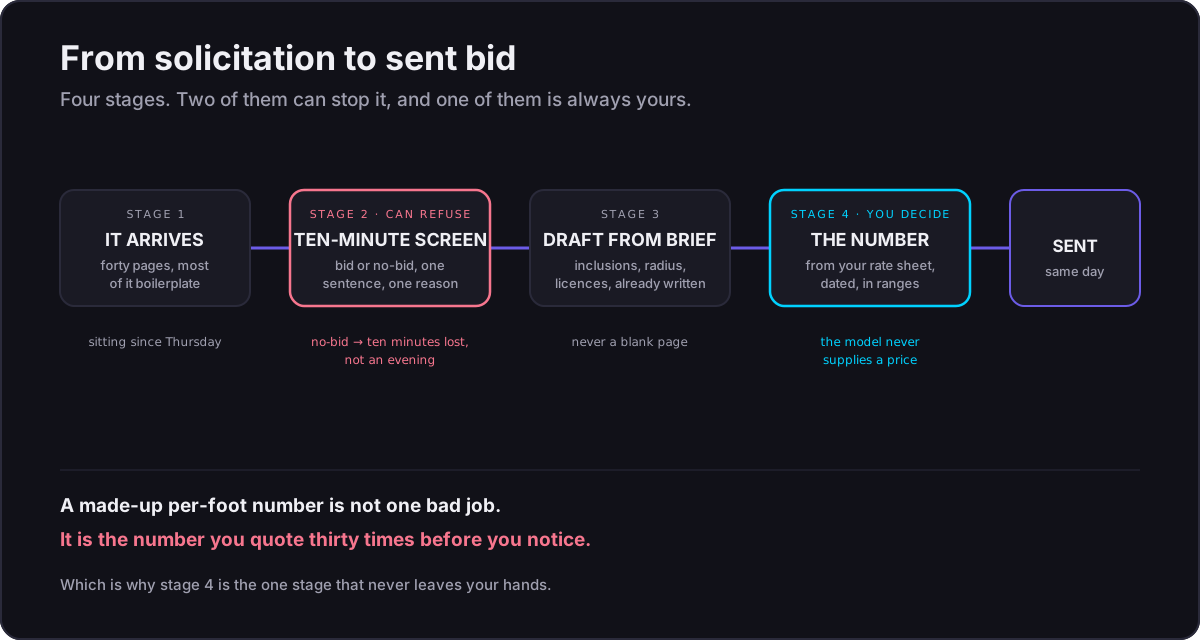
Paste the solicitation into Claude.ai with a prompt that makes the model do the filtering, not the writing. Copy this:
> I run a residential and light-commercial exterior services company. We do pressure washing, gutter cleaning, window cleaning, and deck restoration. We work within about 40 miles of our base. We are a small business with 6 field staff. We are not currently 8(a) or HUBZone certified.
>
> Here is a solicitation. Do not write a response. Answer only these, briefly:
>
> 1. What type is this — Sources Sought, RFQ, or RFP?
> 2. What exactly is the buyer asking to be delivered? Quote the scope line.
> 3. What are the hard eligibility requirements — certifications, registrations, bonding, insurance minimums, past-performance thresholds?
> 4. Which of those do we appear to fail?
> 5. Deadline, and what must be submitted.
> 6. Your bid / no-bid recommendation in one sentence, and the single strongest reason.
>
> If anything is ambiguous, say so rather than guessing.
>
> [paste solicitation]
The instruction "do not write a response" is doing real work. Without it you get an enthusiastic draft proposal for a job you are not eligible to perform.
Read the answer like a screen, not an oracle
The model is good at locating requirements in a long document and bad at knowing whether you meet them. Treat item 4 as a list to check, not a verdict. Registration status, bonding capacity, and past-performance history are facts about your business that live in your records, not in the solicitation.
Three no-bid signals worth trusting immediately:
- A certification you do not hold is listed as a hard set-aside. The award is legally restricted; nothing in your proposal changes that.
- The deadline is inside 48 hours and the submission needs documents you do not already have on file.
- The scope's centre of gravity is a trade you do not perform, with your work as a small sub-line.
One signal worth over-riding: a large total value. Big contracts are frequently multi-award, and a small provider can hold one slot.
What to do with a "bid"
Answer the *cheap* documents generously and the *expensive* ones selectively. A reasonable first-year posture:
- Sources Sought / RFI — answer nearly all that fit your trade. Low cost, shapes the future solicitation, gets your name in front of the contracting officer.
- RFQ — answer when the scope is clear and you can price it confidently.
- RFP — answer only when you can point to comparable past performance. Without it you are paying a day to lose.
Build the reusable half now
Most of a response is the same every time: company details, registrations, insurance, service descriptions, past performance, key personnel. Write that once, keep it current, and reuse it. The next lesson on Continuity shows exactly how to hold that so you never rebuild it — and so a proposal never goes out quoting a stale insurance limit.